Editorial Policies
Focus and Scope
Jurnal Ecopsy is a peer-review journal that focuses on Environmental Psychology in Indonesia. We also accept research with other branches of Psychological, Environmental, and Ecological sciences related to human behavior in Indonesia's environmental issue. "Ecopsy" is the abbreviation "Eco" for Ecology and "Psy" for Psychology.
The example of research topics that are suitable for our journal:
- climate change and behavior
- natural disaster and psychological condition
- pro-environmental behavior
- sustainable environmental behavior
- urban or rural environmental behavior
- behavior in physical environmental settings
- mental health of interacting with environment,
- animal and nature protecting behavior,
- human-environmental interaction, etc.
Jurnal Ecopsy published in the printed version and the electronic version ISSN numbers as follows:
ISSN : 2354-7197
E-ISNN : 2354-7634
Section Policies
Articles
 Open Submissions
- Indexed
- Peer Reviewed
Peer Review Process
Manuscripts submitted to the journal after going through an initial assessment by the Editorial Board will be reviewed by peer reviewers with conditions Reviewers identity unknown to the author and vice versa Identity author unknown Reviewers (Double Blind Peer Review). Thus the submitted manuscript does not contain the author's identity.
Publication Frequency
Published every April and October.
Open Access Policy
This journal provides immediate open access to its content on the principle that making research freely available to the public supports a greater global exchange of knowledge.
Archiving
This journal utilizes the LOCKSS system to create a distributed archiving system among participating libraries and permits those libraries to create permanent archives of the journal for purposes of preservation and restoration.
Publication Ethic
Jurnal Ecopsy is a peer-reviewed scientific journal published by the Psychology Study Program, Faculty of Medicine and Health Sciences, Universitas Lambung Mangkurat, Indonesia, in collaboration with Ikatan Psikologi Sosial (IPS-HIMPSI).
Jurnal Ecopsy is committed to upholding high standards of publication ethics, academic integrity, transparency, and scientific quality. The journal's publication ethics policies are developed with reference to the principles and guidelines of the Committee on Publication Ethics (COPE).
All parties involved in the publication process, including authors, peer reviewers, editors, and the publisher, are expected to uphold ethical standards and fulfill their respective responsibilities to ensure the integrity and credibility of scholarly publications.
A. Duties and Responsibilities of Authors
Authors are responsible for ensuring the originality, accuracy, transparency, and ethical integrity of their research and manuscripts.
- Submitting original manuscripts that have not been previously published or simultaneously submitted to another journal.
- Ensuring the accuracy and integrity of research methods, data collection, data analysis, findings, and conclusions.
- Avoiding plagiarism, inappropriate text recycling, data fabrication, falsification, and manipulation of research findings.
- Properly acknowledging and citing relevant scientific literature, theoretical contributions, and previous research.
- Ensuring that authorship reflects substantial scholarly contributions and that all listed authors have reviewed and approved the submitted manuscript.
- Disclosing research funding, institutional support, and any potential conflicts of interest that may influence the research or its interpretation.
- Obtaining ethical approval and informed consent when applicable, in accordance with relevant institutional and research ethics requirements.
- Protecting the privacy, confidentiality, dignity, and rights of research participants, particularly vulnerable populations, children, disaster survivors, and local communities.
- Reporting research findings accurately and transparently, including relevant methodological limitations and potential implications.
- Providing relevant research information, supporting documentation, or clarification when reasonably requested by the editorial team, subject to ethical and confidentiality requirements.
- Responding to editorial decisions and reviewer comments professionally, constructively, and within the specified revision period.
- Disclosing the use of artificial intelligence tools in accordance with Jurnal Ecopsy's Policy on the Use of Artificial Intelligence (AI).
- Promptly notifying the editor of significant errors or inaccuracies identified before or after publication and cooperating in appropriate corrective actions.
B. Duties and Responsibilities of Peer Reviewers
Peer reviewers play an essential role in maintaining the scientific quality, credibility, and integrity of manuscripts considered for publication in Jurnal Ecopsy.
- Accepting review assignments only when they possess the appropriate expertise and are able to complete the review within the specified timeframe.
- Conducting manuscript evaluations objectively, fairly, constructively, and in accordance with scientific and ethical standards.
- Assessing the relevance of research objectives, theoretical foundations, methodological appropriateness, data analysis, interpretation of findings, and contributions to scientific knowledge.
- Considering relevant research ethics, including informed consent, participant confidentiality, and the protection of vulnerable populations.
- Providing clear, constructive, and evidence-based feedback to assist authors in improving the scientific quality of their manuscripts.
- Informing the editor of any potential conflicts of interest, substantial similarities with previously published work, suspected plagiarism, or other indications of research misconduct.
- Maintaining the confidentiality of manuscripts, unpublished findings, and information obtained during the review process.
- Refraining from using unpublished manuscripts, research data, ideas, or findings for personal or third-party benefit without appropriate authorization.
- Avoiding personal criticism, discriminatory comments, and evaluations influenced by personal or professional interests.
- Providing recommendations regarding manuscript acceptance, revision, or rejection based on scholarly considerations, while recognizing that final editorial decisions remain the responsibility of the editor.
- Following the journal's peer-review guidelines and artificial intelligence policy, including restrictions on disclosing confidential manuscript content to publicly accessible AI systems.
C. Duties and Responsibilities of Editors
Editors are responsible for maintaining the quality, integrity, fairness, transparency, and credibility of the editorial and publication process.
- Evaluating manuscripts based on their relevance to the journal's focus and scope, originality, scientific significance, methodological rigor, clarity, and compliance with research and publication ethics.
- Ensuring a fair, objective, and confidential double-blind peer-review process.
- Selecting qualified reviewers with relevant expertise and appropriately managing potential conflicts of interest.
- Making editorial decisions independently, without discrimination based on authors' nationality, gender, institutional affiliation, cultural background, or other personal characteristics.
- Maintaining the confidentiality of submitted manuscripts and protecting unpublished research information throughout the editorial process.
- Ensuring appropriate disclosure and management of potential conflicts of interest involving authors, reviewers, editors, or other relevant parties.
- Providing constructive editorial feedback and encouraging authors to improve the scientific quality and clarity of their manuscripts.
- Investigating suspected plagiarism, data fabrication, falsification, duplicate publication, inappropriate authorship, or other forms of research and publication misconduct fairly and objectively, with appropriate opportunities for the parties involved to provide clarification.
- Addressing complaints and appeals transparently and taking appropriate action when corrections, expressions of concern, or retractions are necessary, with reference to relevant COPE guidelines.
- Making final publication decisions based on scholarly quality, peer-review recommendations, ethical considerations, and compliance with journal policies.
- Communicating editorial decisions clearly, including acceptance, minor revision, major revision, or rejection. An invitation to revise a manuscript does not guarantee its acceptance for publication.
- Maintaining the integrity of the scholarly record by taking appropriate action when significant errors or ethical concerns are identified before or after publication.
D. Duties and Responsibilities of the Publisher
The publisher of Jurnal Ecopsy is responsible for supporting the ethical, professional, transparent, and sustainable management of the journal.
- Establishing and maintaining the journal's identity, focus and scope, publication frequency, and accreditation information.
- Supporting the appointment and development of qualified editorial board members while maintaining editorial independence.
- Establishing transparent policies governing relationships among the publisher, editors, reviewers, authors, and other relevant parties.
- Ensuring compliance with applicable copyright regulations, intellectual property rights, and open-access licensing policies.
- Protecting the confidentiality of manuscripts, research information, and personal data throughout the publication process.
- Providing adequate administrative, technical, and institutional resources to maintain regular publication, scholarly quality, accessibility, and long-term sustainability.
- Supporting academic collaboration, responsible dissemination of scientific knowledge, and the development of scholarly networks.
- Supporting the fair and transparent investigation and resolution of publication misconduct, ethical concerns, complaints, and disputes while respecting editorial independence.
Plagiarism Policy
Abstracting and Indexing Service
- Science and Technology Index (Sinta score: S3)
- Crossref
- World Cat
- Bielefeld Academic Search Engine (BASE)
- Indonesia One Search
- Moraref
- Google Scholar
- Garuda: Gerba Rujukan Digital
- Dimensions
Citation Analysis:
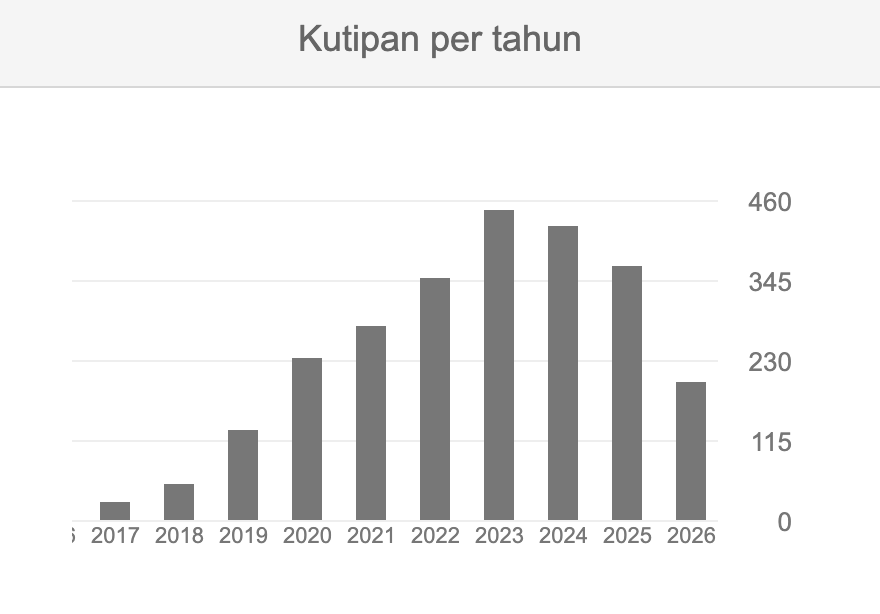
- Google Scholar: citation= 2.659 in December 2026 indeks-h=29, indeks-i10=74; (updated Oktober 2026)
- Scopus: citation=8 (updated August 2021)
Indexed By
1.png)
_(1)_(1)1.png)
_(1)_(1).png)
.png)
 Journal Ecopsy is licensed under a Creative Commons Attribution-ShareAlike 4.0 International License
Purchase of the Print Version
The reader or author will be charged 100,000 (IDR) per issue (excluding shipping costs) when requesting a print version. To request the print version of the issue please click this link: https://bit.ly/pemesananprintjurnalecopsy or contact us at [email protected].
Policy on the Use of Artificial Intelligence (AI)
Jurnal Ecopsy recognizes the growing use of Artificial Intelligence (AI) and generative AI tools in academic writing and scholarly publishing. The use of these technologies must uphold academic integrity, transparency, confidentiality, and human responsibility throughout the publication process.
For Authors
Authors may use AI-assisted tools for limited purposes, such as improving grammar, language clarity, or readability. AI tools must not be listed as authors and must not replace the authors’ intellectual contribution, interpretation, or scientific judgment. Authors remain fully responsible for the accuracy, originality, references, data, and conclusions presented in their manuscripts. Any substantial use of generative AI in preparing a manuscript should be clearly disclosed.
AI must not be used to fabricate, manipulate, or generate research data, results, references, or scientific evidence. AI-generated or AI-modified scientific images should not be used unless their use forms part of the research method and is transparently described.
For Reviewers
Reviewers must protect the confidentiality of manuscripts. Manuscripts, unpublished data, or other confidential materials must not be uploaded to publicly accessible AI systems. AI tools must not replace the reviewer’s own scholarly evaluation and judgment.
For Editors
Editors may use AI-assisted tools for limited administrative or language-related purposes, provided that confidentiality is maintained. Editorial decisions, including assessments of scientific quality and publication decisions, must remain the responsibility of human editors.
Jurnal Ecopsy reserves the right to request clarification regarding the use of AI and to take appropriate editorial action when undisclosed or inappropriate use of AI may compromise the integrity of the scholarly record.
.png)


.png)